





By Dominique Crochu @dominique@repertorium.eu (REPERTORIUM / Neumz)
Late November 2025 brought together scholars, singers, religious communities, students, and chant enthusiasts for two exceptional events in Paris dedicated to Gregorian chant:
the academic colloquium “Interpreting and Transmitting: Gregorian Chant in the Liturgy” (26–28 November), held by EPHE–PSL and the Collège des Bernardins, and the Rencontres Grégoriennes de Paris (29–30 November).
Together, they offered a unique panorama of Gregorian chant as both a field of scholarly research and a living liturgical practice.
1. The EPHE–Collège des Bernardins Colloquium (26–28 November 2025)
Aims and Themes
The colloquium explored the many ways Gregorian chant has been transmitted—from its early oral traditions to contemporary scholarly reinterpretations. Presentations focused on:
- the study of adiastematic and staff-based notation systems
- the evolution of the liturgy
- current pedagogical challenges
- the relationship between musicological research and ecclesial practice
A Notable Contribution: The Question of Si (B♭ or B♮)
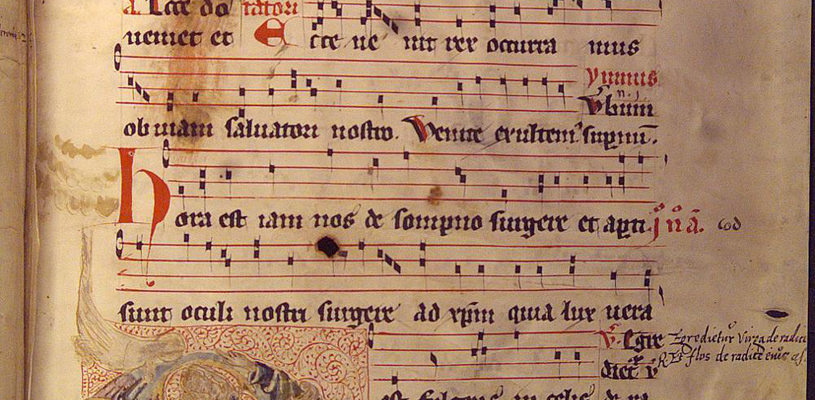
Among the most discussed lectures was the presentation by Dominique Crochu, which offered a groundbreaking contribution to the long-debated issue of the Si—whether and when it should be sung as B-flat or B-natural.
His presentation highlighted:
- findings from his work on the full restoration of Roman Matins, where the treatment of Si plays a decisive role in modal coherence
- insights from the European REPERTORIUM project, enabling systematic comparison between adiastematic and staff-based traditions
- a renewed methodology for distinguishing cases where the mutation of Si arises from modal necessity, scribal habit, or liturgical syntax
This structured and cross-analytical approach was widely recognized as a significant step forward in understanding the Gregorian modal system, especially for pieces whose manuscript traditions present apparent ambiguities.
Participants noted that this research opens the door to:
- reassessing certain modern editions
- improving chant formation
- deepening the link between modality and liturgical rhetoric
Closing Concert
The colloquium concluded with a concert on 28 November featuring Les Chantres du Thoronet, Pérotin le Grand, and Res Severa—an inspiring illustration of the dialogue between research and performance, particularly in Advent repertoire.
2. Rencontres Grégoriennes de Paris (29–30 November 2025)
A Community Gathering of Over 150 Participants
The Rencontres Grégoriennes offered two days filled with workshops, liturgical offices, and opportunities for exchange. The program included:
- extensive workshops: neumatic reading, modality, choral conducting, repertoire analysis, paleography, musical typography
- Masses and offices in some of Paris’s most iconic churches (Saint-Roch, Saint-Sulpice, Val-de-Grâce, Saint-Étienne-du-Mont, and others)
- dialogue between practitioners, researchers, teachers, and students
A Natural Continuation of the Colloquium
Many attendees of the academic colloquium also participated in the Rencontres, enabling a seamless transition from scholarly reflection to practical liturgical engagement. Discussions about the modal system—and particularly the issue of Si—continued organically in the workshops dedicated to modality and Advent repertoire.
Organizers’ Goals
- to offer formation to clergy, religious, laypeople, and choristers according to the principles of the Gregorian tradition
- to foster exchanges across the diverse communities involved in this heritage
- to strengthen the quality and understanding of chant in today’s liturgical life
3. A Shared Momentum: Renewing the Tradition
Both events clearly demonstrated:
- growing interest in a scientifically grounded and historically informed understanding of Gregorian chant
- a desire to enrich the quality of its liturgical practice
- the importance of dialogue between research, edition, teaching, and real-life liturgical experience
In this landscape, the research presented on the question of Si represents an important milestone—one that promises new perspectives for scholars and singers alike.
